On 19 November the Australian Bureau of Statistics (ABS) released its Labour Force figures for October 2026. Within hours, two headlines told a dramatic story.
The Nightly wrote that unemployment had “soared” to a five-year high of 4.9%, and quoted the Treasurer blaming interest rate rises and the Iran war. It also said the labour market was deteriorating faster than the Reserve Bank had predicted.
Market Index went further: “How safe is your job? Australian economy sheds 43,500 jobs”. The article said the labour market, long the economy’s strongest pillar, was “cracking”.
Both articles report the ABS numbers correctly. Seasonally adjusted employment did fall by 43,500, and the unemployment rate is 4.9%. The problem is what they did not report, even though the ABS published it on the same day.
The number is an estimate
The ABS does not count every worker in Australia each month. It surveys a sample of households and scales the answers up to the whole country. If it had interviewed a different set of households, it would have published a different number.
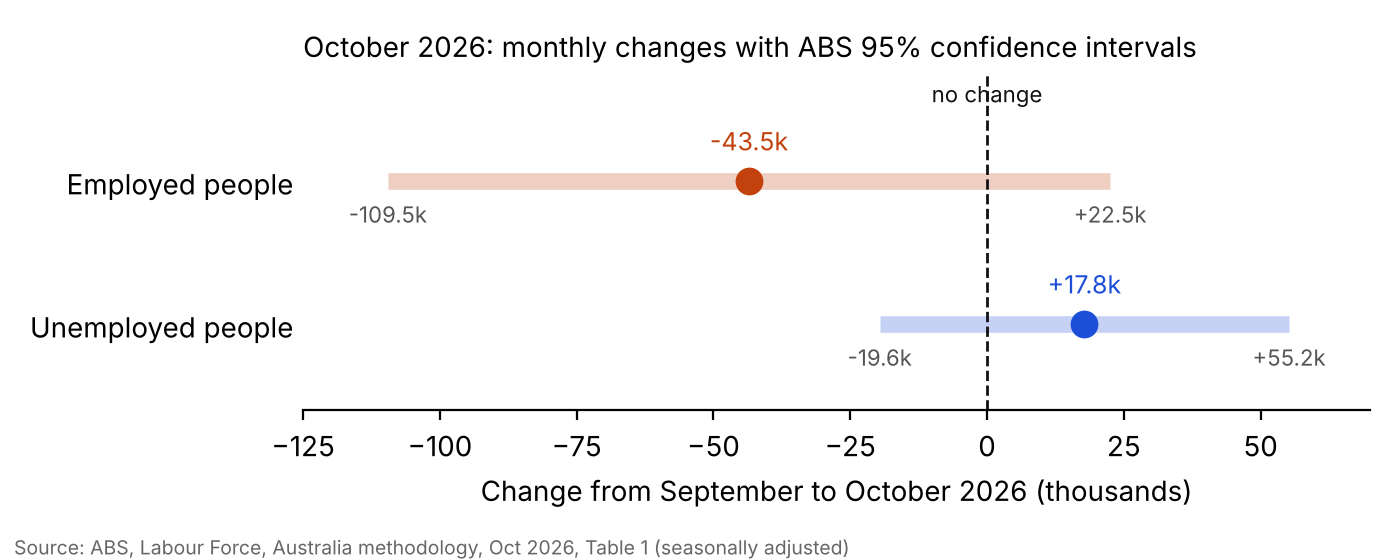
So 43,500 is an estimate, and the ABS tells us how precise it is. In the methodology page for the October release, Table 1 gives a 95% confidence interval for each monthly change:
| Change, September to October 2026 | ABS estimate | ABS 95% confidence interval |
|---|---|---|
| Employed people | -43,500 | -109,500 to +22,500 |
| Unemployed people | +17,800 | -19,600 to +55,200 |
| Unemployment rate | +0.1 pts | -0.1 to +0.3 pts |
Correcting the headlines
“Economy sheds 43,500 jobs.” The ABS’s own interval runs from about 110,000 fewer jobs to 22,500 more. Zero is inside it. The survey is consistent with a large fall, a small fall, or a small rise. It does not tell us that 43,500 jobs were lost. It tells us that this month’s change cannot be told apart from no change.
“Unemployment soars.” The ABS puts the monthly rise in the unemployment rate at 0.1 percentage points, with an interval from -0.1 to +0.3. Zero is inside this one too. Unemployment has risen over the year, and that rise is real. But this month’s move might be zero, and a move that might be zero is not a soar.
“The pillar is cracking.” One month of survey data is too noisy to show that. This is why the ABS also publishes a trend series. It smooths out the month-to-month noise, and the ABS recommends it as the best guide to what the labour market is really doing. In the ABS October release, trend employment did not fall at all. It rose by 7,200. Trend unemployment rose by just 0.1 points, to 4.8%.
In plain words: unemployment has been creeping up slowly since April. That is worth watching. But nothing in the trend looks like a sudden collapse.
What an honest headline looks like
Unemployment drifts up to 4.8% in trend terms; October’s job fall is within the survey’s margin of error.
It is less exciting. It is also what the ABS data say.
None of this means the labour market is fine. Unemployment has been rising for several months, and that slow drift is real and worth reporting. But it is the drift that matters, not a single noisy month dressed up as a collapse.
The lesson
The uncertainty was not hidden. The ABS published it in the same release, one click from the headline numbers. Leaving it out turned sampling noise into a story about cracking pillars and soaring unemployment.
Next time you see a monthly jobs number in a headline, ask one question: is the change bigger than the margin of error? If the article does not say, the ABS usually will.
Sources
- ABS, Labour Force, Australia, October 2026
- ABS, Labour Force, Australia methodology, October 2026, Table 1
- The Nightly, Unemployment in October soars to a five-year high of 4.9 per cent, 19 November 2026
- Market Index, How safe is your job? Australian economy sheds 43,500 jobs as unemployment hits four-year high, 19 November 2026