Suppose your doctor told you in May that you were on track to gain 10 kg by the end of the year. In November she checks again and now expects 9 kg. Good news. But you cannot walk out of her office and say “I’ve been losing 300 grams a month.”
Yet that is roughly what happened in Victoria’s election campaign.
At the News24 leaders’ debate on 17 November, an audience member asked Premier Ben Carroll how he planned to reduce Victoria’s debt. His answer began:
Every month I’ve been Premier, debt has come down $1 billion a month.
Where the number comes from
The number is not invented. On 12 November the Department of Treasury and Finance released the 2026 Victorian Pre-Election Budget Update. On page 12 it says:
Relative to the 2026-27 Budget, the net debt position has improved by $3.1 billion by June 2030, and is largely due to the lower net debt position in 2025-26 that flows through the forward estimates as set out in the 2025-26 Financial Report, as well as additional distributions to the general government sector by public financial corporations (PFC) and public non-financial corporations (PNFC) sector entities.
The 2026-27 Budget was handed down in May 2026. Carroll had been premier for a little over three months. Three billion over three months is a billion a month, which appears to be where the claim comes from.
The bold is mine. 2025-26 ended in June 2026, before Carroll became premier on 28 July 2026. In other words, most of the improvement comes from a year that ended before he took office.
The improvement is real. The problem is what kind of improvement it is.
The debt is still going up
The $3.1 billion is a change in a forecast. It is the difference between what Treasury expected debt to be in 2030 back in May and what it expects now. It is not a fall in the debt itself.
The same document shows what the debt itself is expected to do. Table 2.1 (page 12):
| Financial year (debt at end) | Net debt, general government sector |
|---|---|
| 2026-27 (30 June 2027) | $173.1 billion |
| 2027-28 (30 June 2028) | $181.7 billion |
| 2028-29 (30 June 2029) | $189.0 billion |
| 2029-30 (30 June 2030) | $196.2 billion |
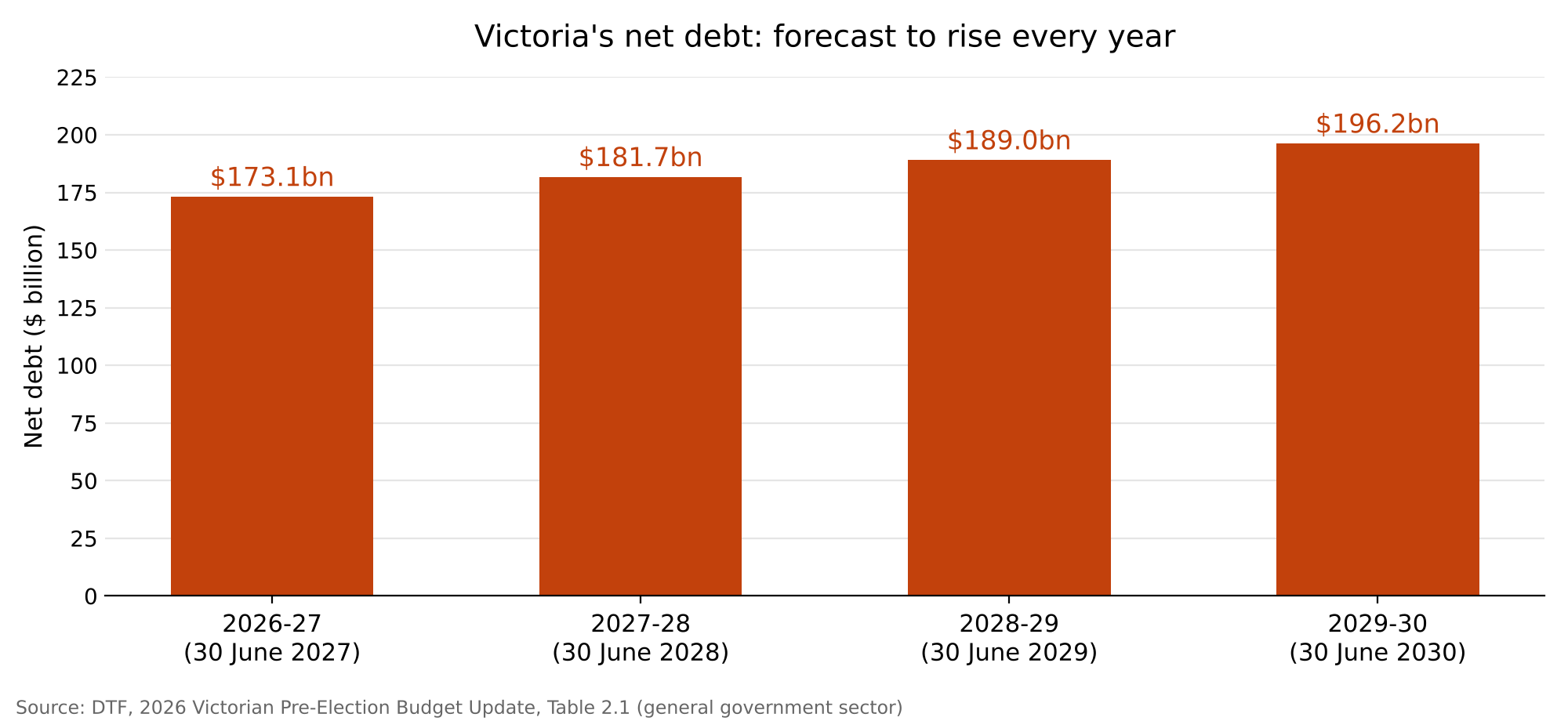
Every year, the debt is higher than the year before. It is forecast to grow by about $23 billion over three years. Treasury now expects it to grow a little less than it did in May. That is the whole of the good news.
What an honest claim looks like
Victoria’s debt is still rising, but Treasury now expects it to be about $3 billion lower in 2030 than it forecast in the May 2026 budget.
It is less exciting. It is also what the Treasury document says.
The lesson
“Down” is a word about a level. A forecast revision is a change in what someone expects, not a change in what exists. Mixing the two turns “rising more slowly than expected” into “falling”.
Next time someone tells you a number has come down, ask one question: down compared with what? Compared with last year, or compared with a forecast?
One last detail from the same document. Table 2.5 (page 21) shows net debt rising by $12.4 billion in 2026-27, the year Carroll has been premier. That is about a billion dollars a month. Up, not down.
Sources
- Department of Treasury and Finance, 2026 Victorian Pre-Election Budget Update, November 2026, Table 2.1 (p. 12) and Table 2.5 (p. 21)
- News24, Victorian leaders’ debate, 17 November 2026
- AAP FactCheck, Premier’s $3b debt reduction claim misleads, November 2026